Rei Vilo's fischertechnik Corner
  • About
  • Blog
  • Reviews
    • How to Start?
    • Controllers >
      • Robotics TXT
      • TXT 4.0 Controller
      • Bluetooth Smart Beginner Set
      • Interface Boards for fischertechnik Models
      • Didacta Advance Pi-F5 interface board
    • Sets >
      • Technical Revolutions Set
      • Pneumatic Power Set
      • Automation Robots Set
      • Electro-Pneumatic Set
      • Starter Set for micro:bit
      • Bluetooth Smart Beginner Set
      • Robotics TXT Smart Home Set
    • Exploring the Lego World >
      • Purchasing
      • Unboxing
      • Installing
      • Building
      • Programming
      • Connecting
      • Playing
      • Expanding
      • Concluding
  • Models
    • Back to the 70's
    • Micro Models
    • New Magasin >
      • Magasin releases 1, 2 and 3
      • Long X-Axis
      • Moving Desk And Y-Axis
      • Compressed Air And Vacuum For Z-Axis
      • Pictures
      • Specifications
    • Power Saving White LED
    • Flipper with I²C LCD Panel
    • Celebrating 50 Years!
    • ft Convention 2013
    • ft Convention 2014
  • Sensors
    • Interfacing an Arduino to a Robo TX Controller >
      • Analog Interface
      • Digital Interface
      • I²C Interface
    • Standard Sensors >
      • Playing With Accelerometers
      • Proximity Sensor
      • Pressure Sensor
    • Advanced Sensors >
      • Industrial Colour Reader
      • Stepper Motor Controller
      • DC-Motor with Quadrature Encoder Controller
    • smartDevices >
      • smartColours
      • smartRFID
      • smartLED
      • smartHub
      • smartControls
      • smartMeter
      • smartCamera
      • smartNewCamera
      • smartWiFi
      • smartBLE
      • smartNode
      • smartIMU
  • RoboPro
    • Value Operations >
      • Min and Max Functions
      • Signal Management With Median
      • Modulo Function
      • Map Function
    • Standard Modules >
      • Software Managed Compressor
      • Self-Calibrated Colour-Reader
      • Standard Conveyor Belt Routine
      • Management Panel
      • Encoder-Motor Position Management
    • Variable Types >
      • CSV List Management
      • Queue Function
    • Program Structures >
      • Parallel Processing
      • Multi-Tasking End Management Procedure
    • Tutorials >
      • Setting Bluetooth LAN with Multiple TX-Cs
      • Dealing with Very Large Models >
        • Getting a General View
        • Defining User's Functions
        • Elaborating the Modelisation
        • Defining the Processes
        • Setting the Messages
        • Going Further
        • References
      • Program Error 2 Message
  • I²C
    • How to Connect an I²C Device to the Robo TX?
    • How to Connect an I²C Device to the Robotics TXT?
    • How to Manage an I²C Device?
    • How to Use an I²C Driver?
    • List of I²C Drivers for Sensors >
      • I²C Real Time Clock DS1307
      • I²C LCD screen 4 lines of 20 characters LCD03
      • I²C Triple Axis Accelerometer ADXL345
      • I²C Red-Green-Blue LED BlinkM
      • I²C Two Axis Compass HMC6352
      • I²C Triple Axis Magnetometer HMC5843
      • I²C True Colour Sensor ADJD-S371
      • I²C Stepper Controller AMIS-30624
    • List of I²C Drivers for smartDevices >
      • I²C True Colours Smart Sensor smartColours
      • I²C RFID Smart Sensor smartRFID
      • I²C 4-Digit 7-Segment LED Display smartLED
      • I²C Screen With Touch and SD-Card smartControls
      • I²C Smart Sensor smartCamera
      • I²C Smart Sensor smartNewCamera
      • I²C Remote WiFi Interface smartWiFi​
      • I²C Remote Bluetooth Interface smartBLE​
      • I²C Remote Interface smartNode​
      • I²C New LCD Screen 4 x 20 characters smartLCD
      • I²C Inertial Measurement Unit smartIMU

Bluetooth Smart Beginner Set​

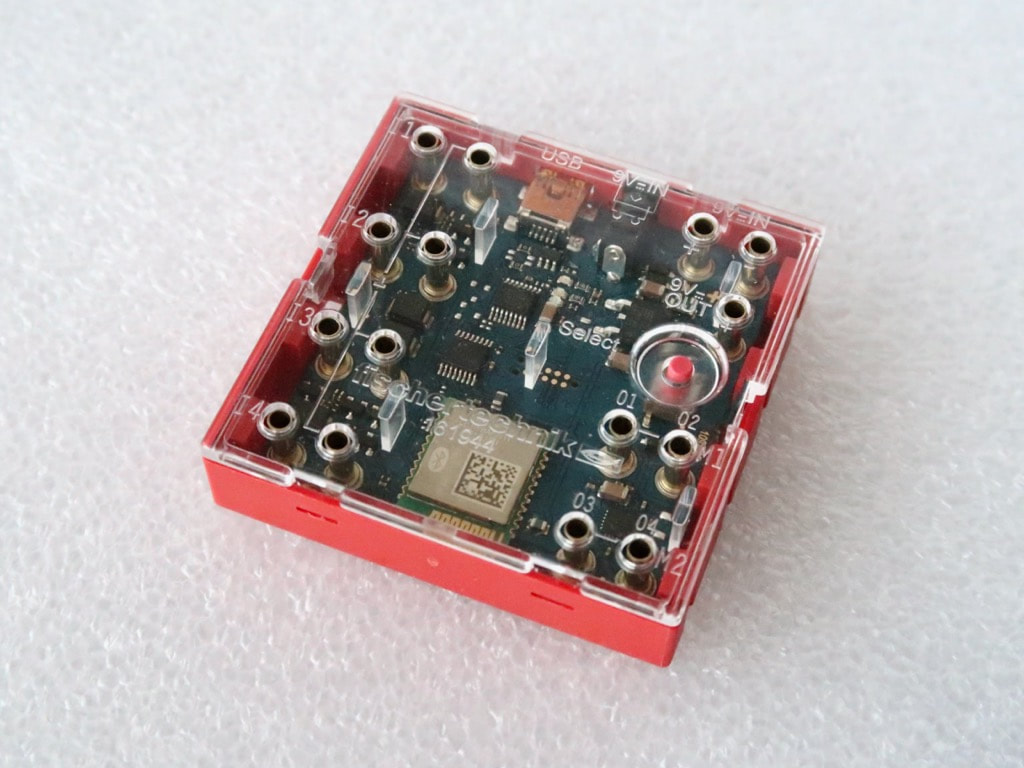
As 2020 brought no novelties on the Robotics line, I purchased the Bluetooth Smart Beginner Set (540586).

​Its equivalent on the Lego world is the Boost controller, also featuring Bluetooth. 

A blue light informs about the Bluetooth connection.
  • If the light blinks slowly, the controller needs to be paired, as all other Bluetooth devices. 
  • To pair the controller, just press the red button for 5 seconds, and the blue light will start blinking fast.
  • Once the the connection on the laptop or tablet has been accepted, the blue light turns solid.

Connecting the controller through USB switches the blue light off. 
Picture

Content

The controller has four inputs and two outputs, to be used with the supplied sensors and actuators:
  • Sensors: two push-button switches, two phototransistors; and
  • Actuators: two mini-motors, two LEDs.

The set includes a case for a 9V battery.

However, I strongly recommend using the PLUS Accu Set (34969, pictured), perfect for mobile robots, or the PLUS Power Set (505283) to be connected to the 3.5 mm plug of the controller.

Models

The set offers twelve models with excellent building instructions, both detailed and clear.

​An additional manual to be downloaded from the e-learning website provides more technical information.

This activity booklet introduces each electronic component, explains how the controller works, and comment the programs for each model.

It is available in six languages: Dutch, English, French, German, Portuguese and Spanish.
​
Picture
Picture
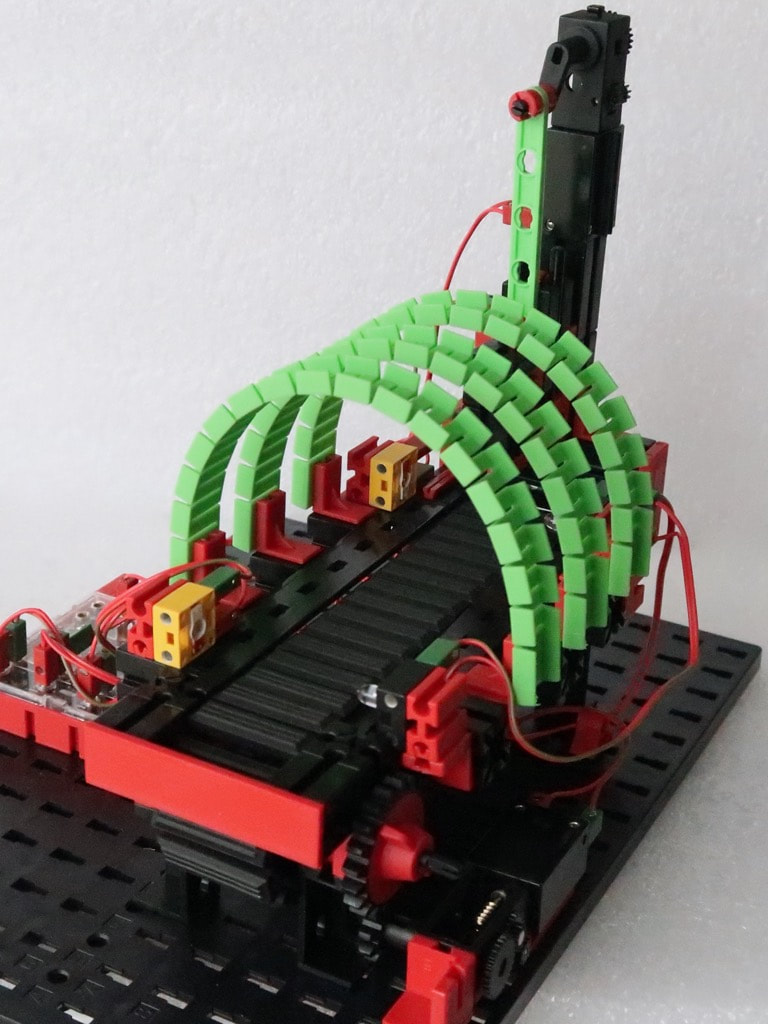
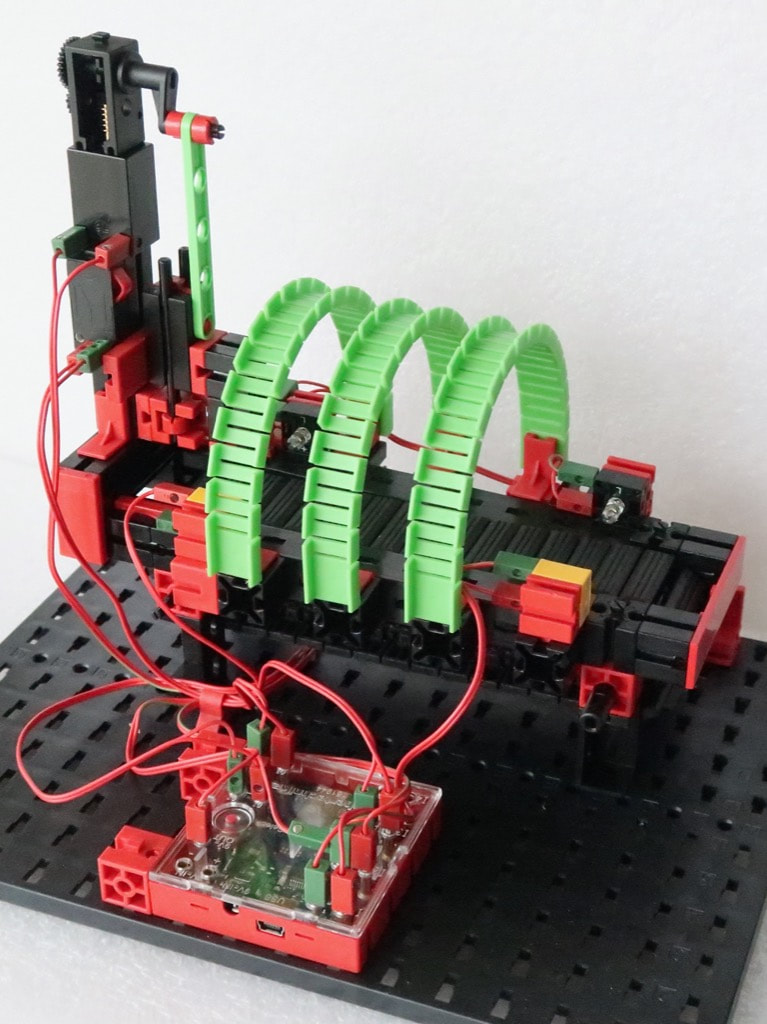
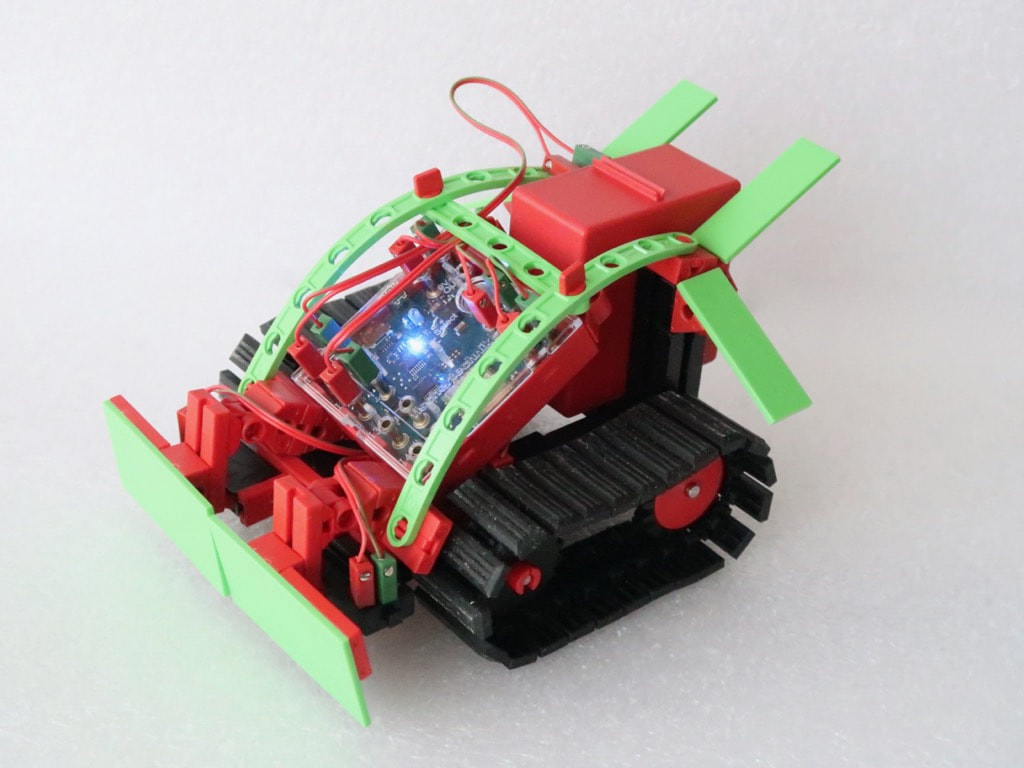
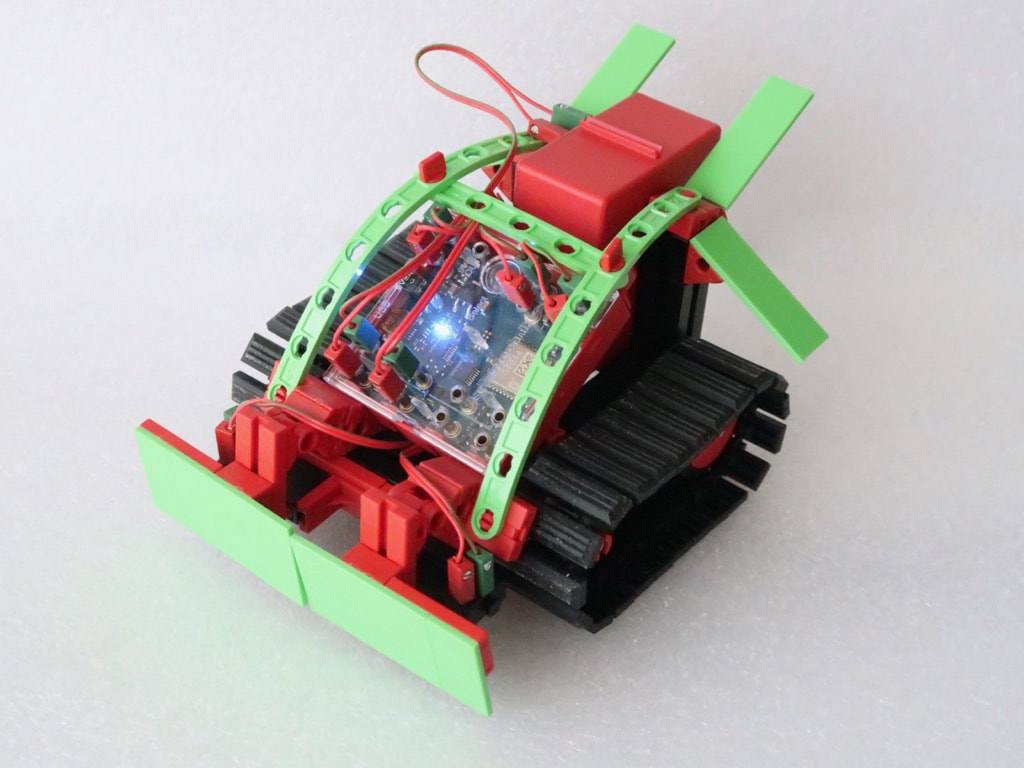
The twelve proposed models include ten static and two mobile robots.
  • Among the static models: a pedestrian light, a washing machine, a conveyor belt and a punching machine (pictured).
  • For the mobile models: a remote-controlled robot and an obstacle-avoidance robot (pictured)
Picture

Control

Multiple options are available to program the robot. 
  • RoboPro Light, a simplified version of RoboPro, for Windows only,
  • RoboPro Smart, an adaptation of the RoboPro Light for Android and iOS tablets,
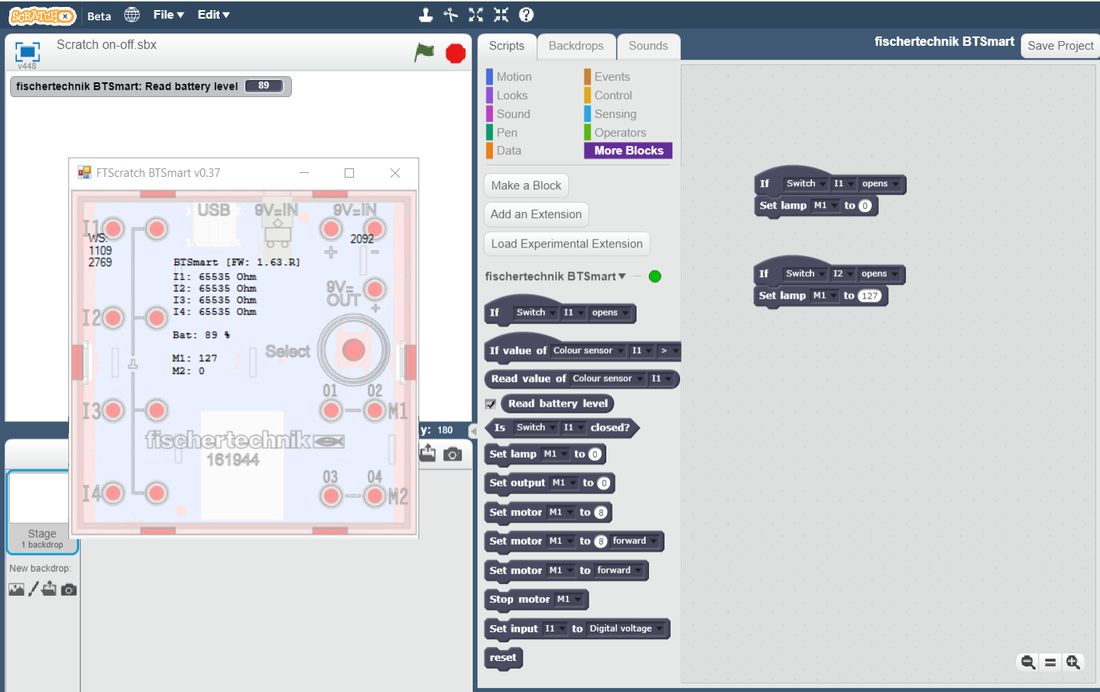
  • FTScratchBTSmart brings the block-based online environment Scratch to program the controller on Windows and Linux,
  • Robo Pro Coding runs on Windows, macOS and Linux as well as Android and iOS. Since release 6.2.0, it supports the Bluetooth Smart Controller as well and features a graphical programming mode based on blocks.

Contrary to the more advanced Robotics TXT and Robotics TXT 4.0 controllers, the Bluetooth Smart controller is passive: it needs to be connected to a PC or a tablet to work. Actually, it operates as an interface. 

RoboPro Light for Windows

The RoboPro Light for Windows application offers two options to connect to the controller: through USB or Bluetooth, as long as the laptop features Bluetooth.

Unfortunately, connection was erratic and unstable. The controller wasn't recognised when plugged-in on an USB port, although the driver was duly installed. When using Bluetooth, RoboPro Light crashed repeatedly.

fischertechnik seems to be well aware of these problems, and recommend to read the document Information about problems Windows 10. Alas, this document hasn't been updated since the end of 2017.

RoboPro Smart for Android and iOS

Luckily, there is the option of using a tablet running on Android or iOS.

Once the controller has been paired, the right pane displays the state of all the inputs and outputs. Additional commands drive the outputs and control the robot remotely.

The development of a program is identical to RoboPro Light on Windows and provides the same set of examples ready to use.

ScratchX for Windows 

Scratch is a development tool based on blocks, similar to MakeCode used with the Starter Set for micro:bit. 

The two scratch implementations rely on a native application to connect to the controller and use online editors. 
  • First, the FTScratchBTSmart application connects to the controller, either through USB or Bluetooth, and displays the inputs and outputs.
  • Then, a browser is used to run the online ScratchX  editor. Alas, it requires Flash Player, banned by most of the modern browsers.

Unfortunately, ScratchX is almost impossible to use. It is only available online, requires the Chrome or Firefox browsers, relies on Flash Player, and is dramatically slow. 
​
Picture

ftScratch3 for Windows

Actually, fischertechnik now recommends ftScratch3. ​It requires the same ​FTScratchBTSmart application and also runs online on a browser.

A dedicated extension for ​ftScratch3 provides a rich assortment of blocks for fischertechnik sensors and actuators. During my tests, it worked very nicely.

The same environment also supports the Robotics TXT Controller.

Robo Pro Coding

The RoboPro Coding application runs on Windows, Linux and macOS as well as on Android and iOS. It features a graphical programming mode based on blocks. On Windows, Linux and macOS, the computer can connect to the controller through USB or Bluetooth, as long as the computer features Bluetooth.

As for the Robotics TXT 4.0, the first step is to select the controller, here BTSmart, and configure all the inputs and outputs. The elements which are not supported by the Bluetooth Smart Controller are greyed out.

Then writing the program can start. The blocks are grouped by functions with dedicated colours. Only procedural programming is supported.

Conclusion

I like the compact controller and its features. Along the proprietary RoboPro Light application for Windows, Scratch (ftScratch3, not ScratchX) offers an interesting alternative. Alas, connection on Windows, either USB or Bluetooth, suffers from numerous stability issues. Bluetooth works great when used with a tablet. 

The updated Robo Pro Coding application release 6.2.0 now supports the Bluetooth Smart Controller. It offers blocks and supersedes Scratch. Unfortunately, Python is not supported.

​This set could be used at different levels: just playing with the models and the supplied programming examples, or explore the electronic components and the development options.

Competition is fierce from other fischertechnik products. For example, the Starter Set for micro:bit priced at 150€ (set 130€ + BBC micro:bit 20€) is cheaper than the Bluetooth Smart Beginner Set listed at 180€. Moreover, the BBC micro:bit offers a wider range of reliable options for development, is an active controller as it can operate without a connection to a PC or tablet.

However, it is not clear whether and how the controller integrates with the Robotics TXT and TXT 4.0 controllers, although fischertechnik discloses the full USB Serial Protocol but provides no examples and no use cases.
Picture

Pros

  • Wide choice of models​
  • Excellent documentation 
  • Robo Pro Coding with blocks

Cons

  • ​Some connection issues on Windows 
  • Connection to a PC or tablet to run

Wrap-Up

  • Wide choice of models​
  • Reliable application for tablets
  • Excellent documentation 
  • Some connection issues on Windows 

Links

fischertechnik website
Product page
​E-learning page

Posted: 06 Mar 2020
​Updated: 14 Mar 2020, 14 Oct 2023

Powered by Create your own unique website with customizable templates.